

Legacy and Continuity: Willow Pattern Ceramics and
Stories of ‘Other’ was commissioned by Stoke-on-Trent
City Council as part of its centenary celebrations.
Legacy and Continuity: Willow Pattern Ceramics and Stories of ‘Other’ was
funded by Arts Council England, Stoke-on-Trent City Council, National Lottery
Heritage Fund; with support in kind from Dore and Rees, KMF Group, Spode
Museum, Potteries Museum & Art Gallery, The Brampton Museum, 1882,
Newcastle-Under-Lyme Borough Council, University of Staffordshire,
Jingdezhen Ceramic University, Holdway Collection.
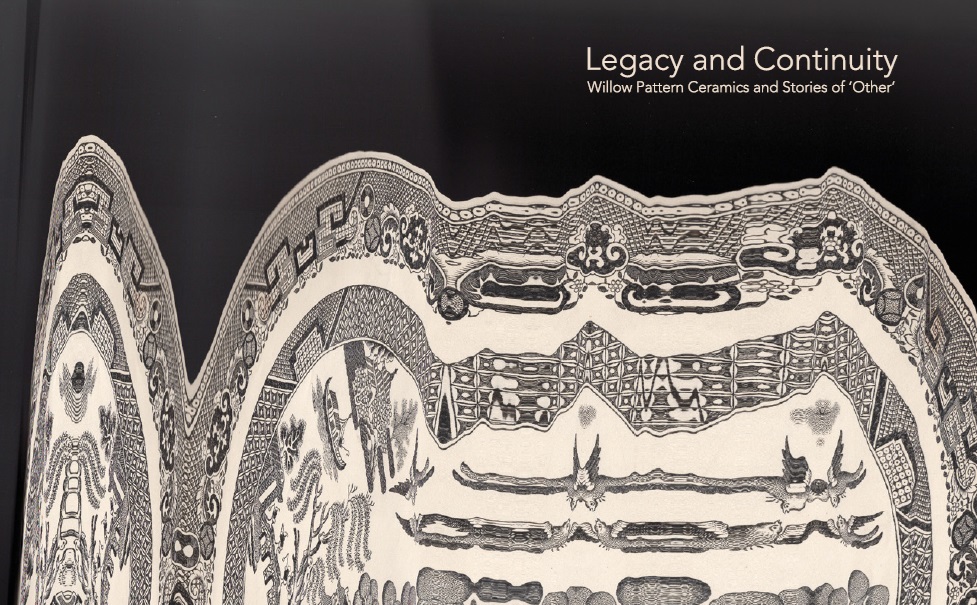
In 2025, Stoke-on-Trent City Council marked the centenary of the City’s status, conferred by King George V, through a year-long programme of cultural events. Among these, the exhibition Willow Pattern Ceramics and Stories of ‘Other’ was commissioned to critically reframe understandings of one of north Staffordshire’s most iconic and globally disseminated ceramic designs. Curated by Professors Neil Brownsword (C3 Centre, University of Staffordshire) and Tiejun Hou (Jingdezhen Ceramic University), the exhibition brought together objects from regional museum collections and private holdings to interrogate the complex and often paradoxical entanglements of Chinese ceramic traditions and British industrial production.
This recently published catalogue and conference proceeding emerges from this landmark year in Stoke-on-Trent’s cultural history, marking the centenary of the City’s status through a programme of events that celebrated and critically examined its rich ceramic heritage. At its centre was the exhibition Willow Pattern Ceramics and Stories of ‘Other’, which explored the complex histories, exchanges, and reinterpretations that have shaped one of the region’s most iconic ceramic designs.
Bringing together perspectives from China and the United Kingdom, this publication examines the Willow Pattern as a lens through which to understand centuries of cultural transmission, artistic innovation, industrial production, and global trade. The essays collected here offer new insights into the interconnected histories of Stoke-on-Trent and Jingdezhen -two of the world’s most significant ceramic centres.
Together, these contributions reflect a shared commitment to advancing dialogue, research, and cultural exchange, while demonstrating how ceramics continue to provide a powerful framework for understanding the enduring legacies of cross-cultural encounter and creative reinvention.